 Mike Redwood
September 11, 2024
Navigating today’s complex geopolitics
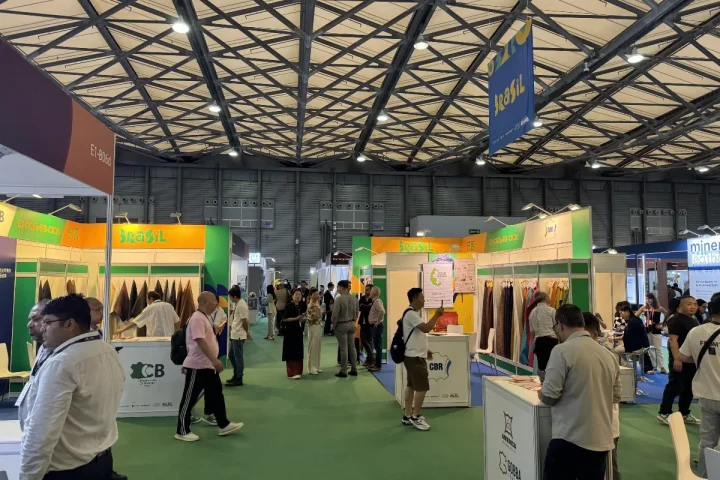
Amid so much gloom, there is no doubt that the All-China Leather Exhibition (ACLE) in Shanghai was a great success and a morale booster for all who attended. I was sorry not to be there to absorb the atmosphere.
I have been privileged to watch the transformation of China over the last four decades, having first visited in the early 1980s. Shanghai was a special place in the mid-80s. Using a translator and going round in Volvo taxis was the norm; and the taxi driver joined you for lunch. The Pudong side of the river was mostly rice fields, the Bund was still offices and elevators up to anything above the fifth floor were slow, noisy and a bit scary. Bicycles were everywhere and any motorised transport was either small minibuses or decrepit lorries.
My first trade show in Shanghai was in 1993 and very much an experiment, in a hotel basement with primitive stands. It was a delight when the ACLE began in 1998 and I attended most of them until the Covid interruption brought my intercontinental travel to an end.
For many of those years, the return flights to the UK included many students going to British universities and, during the years I was a part time Teaching Fellow at the University of Bath, they were the bulk of many classes. Those days seem to be gone and European airlines are now cancelling direct flights because of reduced traffic and costly routing to avoid Russian airspace.
Could ACLE eclipse APLF?
At one stage, ACLE Shanghai looked like it might eclipse APLF, but largely through clever management the two stayed alive and relevant. Different audiences, albeit with a hefty overlap, and varied targets highlight the significance and complexity of the whole region. With geopolitics impacting the leather industry so quickly these days, well-organised trade fairs can be good to help management contextualise the likely impacts of global events.
Tanners have a history in the last century of setting their network boundaries too narrowly when looking for organisations and events that will create impact, like an army being modernised to fight the last war. In earlier history, leather was such an embedded material in strategically vital areas that fast response was the industry norm. Do not be confused by the absence of change in the fundamental technologies, tanners were still able to quickly adapt to contemporary needs.
This century, the rise of autocratic leadership on the back of discontented citizens has given us the likes of Trump, Erdogan, Orbán and Modi, plus the reversing of China’s open society approach by Xi Jinping. This has made the global picture less predictable. Add in the pandemic, Ukraine, inflation and a total supply chain highlighted by the meltdown when just one big vessel crashed in the Suez Canal, and these are indeed difficult times. And do not forget climate change.
These columns have highlighted how new world groupings are being formed along similar lines to those predicted by George Orwell decades ago. Some specific items are worth noting. Hungary has become by far the biggest recipient of Chinese direct foreign investment in Europe, giving Chinese companies a route to escape some of the potential future tariffs while, at the same time, making it harder for the EU to harmonise its political thinking over matters such as Ukraine (and Taiwan if its factories employ lots of EU workers). Meanwhile, the U.S. is shifting its imports away from China to Mexico and elsewhere and overall trade between China and the EU has continued to grow.
The EU should note that, in 1980, the EU’s GDP was five times that of China. Today, China’s GDP is larger and growing. Many of us have watched it happen and we have many leather people who have tanneries and other investments there.
Good friends
Chinese leather and leather-related research has also started to mature. Whereas 15 years ago, hundreds of papers created little new knowledge, we can observe a steady change with the practical outcomes from tanneries and associated businesses. We have made many good friends just as geopolitics makes things difficult.
China and Russia have been building strong ties in Africa while the U.S. has been busy in mass introspection and Europe diverted by internal politics and Ukraine. And the EU is not helping itself by passing careless laws on deforestation. It may be well intentioned but, in battling emerging economies, the EUDR looks very like the old-fashioned colonial mentality revisited; and it is ideology rather than science that drags in leather.
China has been establishing back door routes into the U.S. to get around current and likely future tariffs. As well as Hungary, China has been investing heavily in Mexico, and locations such as Malaysia are gearing up as new manufacturing hubs, while Vietnam has become expert in trans-shipping methodologies.
China has also rapidly expanded its trade elsewhere, obviously doing well in Russia, and it has surpassed the U.S. in trade with India. Its excellent cheap electric automobiles make attractive exports in most parts of the world, as it exploits the western car makers “will we, won’t we” attitude towards advancing into fully-electric cars – a muddle that is damaging many other industries on its way.
Important leather producing centres, such as India and Turkey, are playing delicate diplomatic games amid the complex Russia, China, U.S. and EU mix, which we can only watch from afar. But total insulation would never be good for leather. Hides and skins are not a commodity, and the important diversity covers the globe: we need to try and keep trading, keep talking and stay friends.
Managing this muddle and escaping harm when inevitable interruptions arise requires strong balance sheets and a clear strategic focus. Understanding your competences, maintaining quality and innovation while supporting your trade associations and the communications bodies will be essential. And keep going to the industry trade fairs!

Michael Redwood
Leather chemist, writer, and advisor on responsible leather manufacturing and material strategy. This article was originally written for ILM.