 Mike Redwood
August 21, 2024
Leather Naturally Skilled work and crafting leather
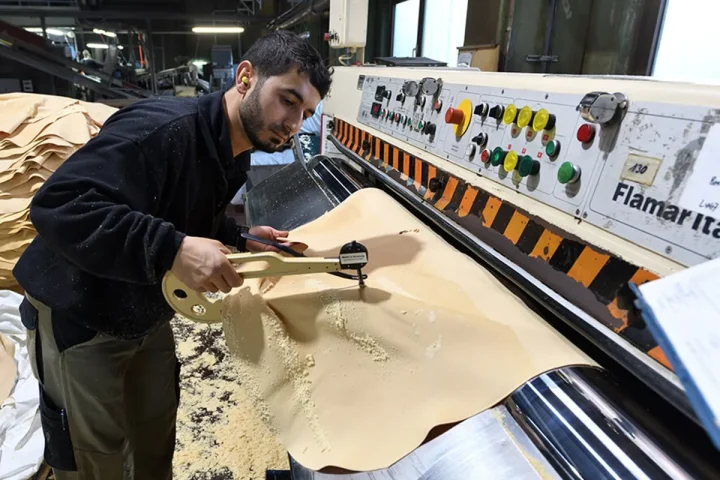
A recent peer reviewed study has once again identified the many societal benefits of the creative arts and crafting “as a useful strategy to improve wellbeing at a population level, with the positive effects observed… being comparable to or greater than known sociodemographic predictors of wellbeing”.
This aspect of the social benefits derived from the leather industry was hinted at in an ILM article five years ago, but seeing some of the startling headlines based on this research does bring it into sharp focus.
I started working in tanneries when they were tough places. Output, defined through time and motion studies, controlled almost everything. Quality, cleanliness and frequently humanity were lower in importance than getting the volumes through, especially in the new side leather units.
Evolving attitudes since then have seen more thought and care impacting all aspects of tannery work. Back then, only shavers were classed as skilled workers (in this Yorkshire tannery, splitting was a family affair and agreed to be passed from father to son, so no one else could even observe the weekly maintenance check).
Today, in most of the world, the tannery workforce is treated with respect and properly trained. Their understanding of leather is considerable, and quality is usually a matter of discussion rather than instruction.
As much an art as a science
One can safely say that everyone is skilled in the modern tannery and a member of a team that comprehends the importance of quality, consistency, product performance and leather’s inherent beauty. Nowadays, tanning is as much an art and craft as it is a science and I believe that many of our longstanding employees and staff stay involved in large part because they love this aspect of the product.
Throughout the entire leather supply chain, everywhere we look we find people – from farmers through tanners to leather workers – with the desire to do a job well for its own sake. Some of what we saw in the 60s, 70s and 80s was an aberration as the industry battled with chrome-tanned side leather.
In the early days, much of this leather, excluding calf and veal skins, was produced as pigmented corrected grain. The footwear industry liked injection moulding and chrome-tanned leather that stood the boil was specified. In the huge American side-leather tanneries, immense outputs per worker were achieved, helped by the use of paste driers which required everything to be fully buffed and corrected, or occasionally snuffed to a velour type.
As the Italian industry pulled leather towards a more natural and beautiful appearance using prints, dry drumming and clever finishing, control had to change. What was adequate for totally standard corrected grains and bulk-produced vegetable sole leather no longer worked. Whoever thought it was wise to process sides with bits of shoulder and belly attached to make a beautiful aniline leather with a tight grain had a sandwich missing from his lunch.
As some of our older tanners think back, they might recognise a subtle change after the mid-80s, as process thinking adjusted to stabilise quality. A lot of it centred around renewal of equipment, aided by the accelerated closure of inefficient city centre plants in inappropriate buildings and their replacement with new facilities locally or overseas. Technicians and all staff focused on quality and adherence to specification. Surreptitiously, but quickly, the total craft element rejoined leather making at the same time as leather became an “engineered” product.
Leather teaching needs a rethink
What we see now is a need for a big rethink about training. Requirements for skills, apprenticeships and higher education are not in balance for the leather industry, in part because we still often consider basic jobs unskilled.
Throughout the modern service sector, we see issues that point to the fact that almost no jobs are unskilled. Merely because a university qualification is not required does not mean that workers are unskilled and do not require full training. For the last quarter of the century, this has been an increasing problem in the UK, and how badly the existing British workforce has been trained is now a big issue. We must correct this for leather and learn the lesson globally.
Fulfilling work requires commitment and satisfaction
As well as having the right skills, fulfilling work requires commitment and satisfaction. Leather offers this to all its workforce at every level and tanners should consider this when looking at the training needs for every role. You have no unskilled staff.
And remember that many jobs are created for every hide or skin produced on a regular basis. Be it for shoes, bags, gloves or garments, the multiplier in terms of jobs created is enormous and underrated.
At a time when modern diseases like diabetes, myopia and allergies, often associated with urbanisation and a lack of getting outside amid nature, are all proliferating, we dare not add mental health problems to the list. The leather industry, with its increasing emphasis on art and craft and the love of doing things well, is a vital aspect of not just saving the planet but humanity itself.

Michael Redwood
Leather chemist, writer, and advisor on responsible leather manufacturing and material strategy. This article was originally written for ILM.