 Mike Redwood
October 30, 2024
Leather is versatile
Leather is versatile. Different animals and the skill of the tanner mean many types of leather can be made for an infinity of end uses, many overlapping. As well as the physical properties of the leather, the sensitive tanner adjusts the aesthetics to suit wide variations in customer preference.
Leather is curiously popular with many different societal groups. A much-overlooked study by Anka Roberts 15 years ago helps explain how, over centuries, leather has shown itself a material capable of reinventing itself as society evolves.
Roberts demonstrated that leather has complex associations such as status, luxury lifestyles, archetypal images, art, style, fashion and sexuality (including leather subcultures, fetish material) as well as heroes and villains. It does not matter if some are opposites since the contexts are so distant.
From the luxury handbag to the aviator jacket, the consumer can oscillate between sophistication and the “tough guy”. From the epitome of quality and taste to excitement and seduction, leather has a role. From the classic and the glamorous to pushing the boundaries. For others, it is enough that it is a long-lasting material that creates a good feeling with every use. When marketing was fixated on tribes, Nike told us that their customers could be in two tribes in the same day – for example, a student in the daytime and a classical musician in the evening.
Myriad of uses
According to Ulinka Rublack, in 16th century Europe, leather was found in an “amazingly wide range of goods such as stamped cases, bags, book bindings, furniture, cushions, shields and saddles to gilded wallpaper, belts, gloves, doublets, hose, caps and footwear”. Spain was a major source and was bringing in raw material from Africa and the Caribbean. With such a big growth in the demand for leather pulled by a desire for luxury goods Rublack indicates that Spanish leather was often by this time a global agglomerate rather than a local product.
So many different leather types were developed in Spain in the period following Roman rule that this is not surprising. The famous gilt leather began as an embossed alum-tanned hairsheep but, over time, evolved into vegetable-tanned calfskin used primarily for wall hangings. Today, we find the term Spanish leather covering a wide variety of skins and leathers.
Leather paintings in the Alhambra
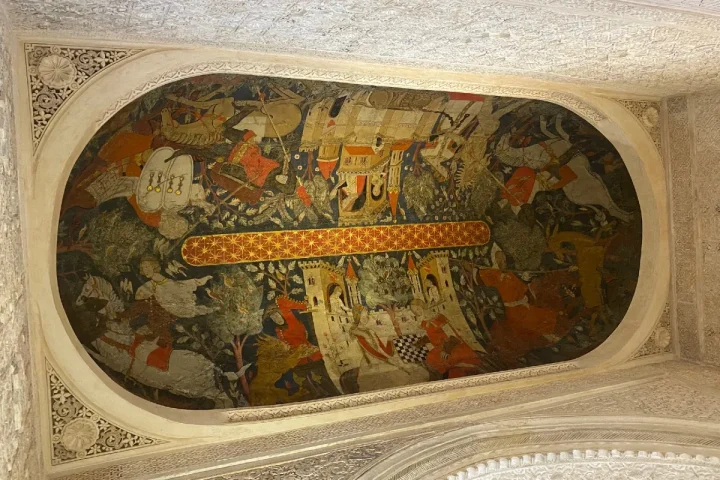
Artistically one of the most remarkable sights from the period of dramatic technical advancement are the three large paintings in ceiling cupolas in the Alhambra in Granada, just down the road from the former leather capital, Cordoba.
The Alhambra is described as the largest political and aristocratic centre of the Moslem West. It is a huge hilltop area mixing palaces and forts with beautiful gardens. The advanced technology on show is outstanding, not least the diversion of the river to fill reservoirs with cool water from the melting snows, which was then ingeniously fed through buildings and gardens with fountains and waterfalls keeping inhabitants cool all through the year in one of the hottest areas in Europe, before running down the hill to rejoin the river below. Some of these “lost” ideas are being reintroduced today to help cool overheating Andalusian cities.
Within the complex, there was a small tannery, built very much like a small version of those found in northern Morocco. As such the Alhambra is the most important heritage built in the Islamic period of 711-1492. Within the Alhambra are the Nasri Palaces, built by the Nasri Dynastry, which ruled the Kingdom of Granada from 1238 until 1492. They are marvels of Islamic decoration, using plasterwork accompanied by ceramic mosaics and exquisite carpentry.
Here, the Palace of the Lions was built in the second half of the 14th century with a magnificent central fountain with 12 lions. The rooms around it includes the Hall of the Kings, named because the central picture on the ceiling shows the Nasri Kings with two adjacent pictures showing hunting scenes and daily life.
These required the combined skills of the artist, the tanner and the carpenter. They are not, as might have been expected, the embossed leathers that we call gilt leathers, but painted pieces where the leather is only one, vital element. The basic framework ,which creates the required curved cupola, was made in wood to which leather was attached and then painted. There was a foundation layer of gypsum followed by the pigments and gold leaf to create the scenes.
The leather is alum-tanned sheepskin, skived at the edges so the joins are no thicker than the whole, and it is bound to the wood using wood flour glue and secured with bamboo nails which push the leather into position but do not penetrate it. The gypsum primer is held with animal glue and the pigments with egg yolk.
Much of this has to do with short and longer-term climate protection. The wood flour glue did moisten the leather, but care was taken not to let it get too wet and lose some of the alum, plus the evenly damped leather was laid neck to butt when joined to limit differential movement from shrinkage as it dried. The use of egg yolk helped stop the entry of moisture and the wood would have been given various treatments to avoid shrinkage or bending over time – the reason that bamboo nails were chosen over wooden ones.
The latest conservation only a few years ago used non-destructive testing to show that the reds are cinnabar and/or hematite, the flesh colour is cinnabar and hydrocerussite and the greens malachite and oropiment (a toxicity issue for conservators). Blues are lazurite and azurite. Gold leaf was used although some gold colour is built over tin leaf.
Still in good condition
700 plus years on, like so many items of leather, the pictures are in remarkable condition. The latest conservation appears to have been more about repairing damage caused by previous interventions, not least a major change to the outer roof in 1855, which led to the entry of water and humidity. This caused peeling and curling at the edges and pulled out the bamboo nails.
Discussions continue as to whether the artists were Christian or not, as the scenes of chivalry and daily life are not Islamic, and the detail of some of the swords on the Kings are incorrect and sloppy in a way unlikely to be done by a Moorish artist. Yet, the outlining in black of the initial drawing, which remains obvious in parts, was normally done by Christian painters.
Yet, for tanners, we can be pleased that these questions can only be asked today because once more we have an item where leather provides the foundation. Thanks to the immense skills of the craftsmen involved, it remains largely undamaged to provide us with these masterpieces which modern experts are able to study, interpret and reinterpret. Another of the many unusual uses for leather that proves its versatility, adaptability and enduring qualities.

Michael Redwood
Leather chemist, writer, and advisor on responsible leather manufacturing and material strategy. This article was originally written for ILM.