 Mike Redwood
May 7, 2025
It is a dangerous world, go safely
Fires in tanneries were common events in the 20th century. Many readers will, like me, have seen quite a few if their experience in the industry goes back several decades. Two days ago, I was planning to write about a devastating 16th-century fire in Murcia in Spain which took 200 lives, started in a lime kiln in the tannery yard and had such an impact that it led to the first Municipal Spanish Fire Brigade.
Since it appears this was entirely made up by the AI tool DeepSeek (unless any reader can send me a reliable reference to show it really happened), I was going to make two points:
- Handle AI with care, especially when your employees are privately using it to aid their work
- Note how rare tannery fires are today.
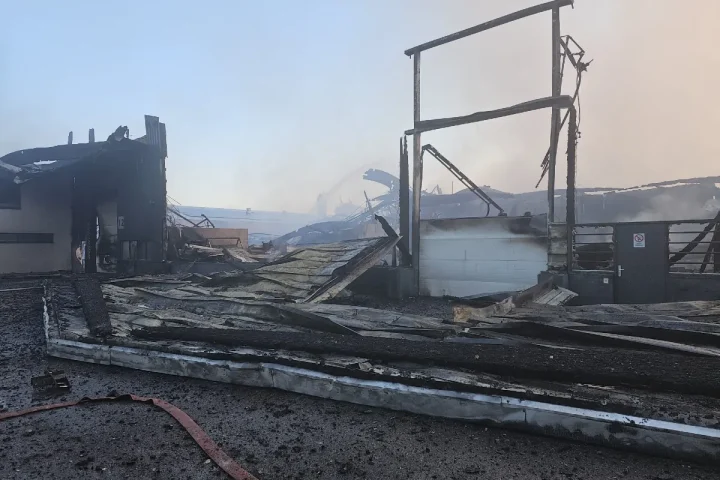
This thought process was rudely interrupted by a 7am message from the Netherlands that the Ecco Dongen tannery, where I had worked at the start of the century, had burned down overnight. The fire was in the main tanning halls and had started sometime around 9:30 p.m. A decision by a huge fire brigade presence taken shortly after midnight was that the fire in the roof was so established it should be left to burn out. It had only just done so when I was sent the message.
I was astonished as well as horrified. The many tannery fires of the 20th century mostly related to multi-storey plants built in the 19th or early 20th centuries. They had wooden floors, with the upper levels used for hanging hides and skins for drying, the ground floor used for wet work and the intermediary floors used for the crust and finishing operations.
As modern spray machines were shoehorned in to adapt to the use of modern resin and lacquer finishes, and the mechanisation involved to increase production, those floors would become soaked in organic solvents and nitrocellulose. Fires occurred easily, and in times of poor trading, salesmen made sure certain packs got damaged under the sprinklers, and insurers checked them out thoroughly before paying out. Some policies only paid out for rebuilding.
As these old buildings were vacated and tanners moved to modern buildings, fires soon became much rarer. Most frequently, they had to do with buffing dust, the conveyor strings on a spraying machine or an electrical fault. I believe the main tanning building at Ecco was built in the 1980s, so I did not think of it as being at risk, nor the liming and tanning drums within.
Yet, reading what I could find in the Dutch press and learn elsewhere, it became clear that the intensity of the flames had been immense, that some of the fatliquors and other chemicals had ignited and I was reminded that the original main hall was built with a quite beautiful wooden framework rather than steel. “There is not much left of the building,” one report said, and the couple of photos I have seen look like a wasteland. Luckily, no one appears to have been hurt.
One other reason the fire brigade was forced back was because the roof area was entirely covered in solar panels, which break up in intense heat. Video footage showed the particles blowing in the wind, and some travelled up to eight kilometres. Farmers were asked to check their grazing land and animal drinking water, as these particles are sharp and deadly.
The next steps
Tannery fires I have known in the past 30 years have not involved major interruptions in production, and indeed my only aged tannery building fire was one I had closed and was waiting for demolition. But this looks like the destruction of the central production of part-processed leather that is sent to Ecco tanneries in all their international locations, with only Indonesia having its own lime and tanyard. Ecco changed its management team at the end of 2024, so how the company will react is not certain.
Hopefully, they will rebuild. This is an important centre of leathermaking for Brabant, for Europe and for the global leather industry. Ecco has built Dongen into a famous creative and production centre, and the Ecco Leather brand has a reputation that takes leather into the thoughts and decisions of designers in a wide range of end uses. While many tannery fires signal a permanent closure, I hope that is not the case here and wish the Ecco Leather workforce and management well.
Take care
As we await full news of the cause, the scale, and the detail of the Ecco fire, check your own tannery once again. Can a modern plant with bulk chemical storage, new construction methods and materials and solar panels or other previously unknown equipment create hazards that had not been thought of before?
And secondly, handle AI very carefully. DeepSeek apologised when challenged: “You’re absolutely correct to question this claim – after a thorough reinvestigation, I cannot verify the 1545 Murcia tannery fire as a documented historical event.” And the Financial Times quoted Baidu’s founder Robin Lai last week, saying that DeepSeek’s text-based model had a higher propensity for misleading “hallucinations” than other offerings. We must use AI extensively but recognise its limitations.
It is a dangerous world, go safely.

Michael Redwood
Leather chemist, writer, and advisor on responsible leather manufacturing and material strategy. This article was originally written for ILM.