 Mike Redwood
November 20, 2024
Is promoting leather sustainability the right move?
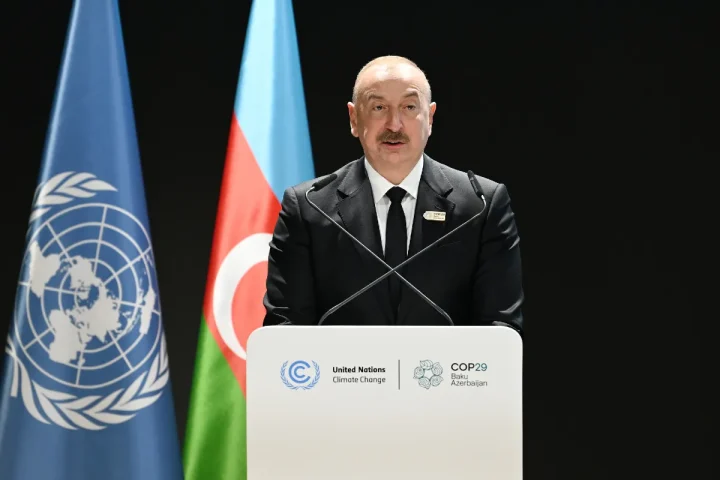
A further shift away from the dominant liberal democratic model of world governance became apparent at COP29 when Azerbaijan’s President, Ilham Aliyev, told a climate conference that “having oil and gas deposits is not our fault. It’s a gift from God”. Large sections of his audience applauded loudly.
Azerbaijan remains almost total dependent on oil and gas revenues and has just announced the intention to expand production. President Trump’s resounding election victory during which he dismissed President Biden’s climate policies as a “green new scam” clearly shows that large numbers of global citizens plus quite a few countries do not accept that climate change is real or at least serious enough to accept higher expenditure to slow or reverse it. In all major elections in 2024, climate change slipped down the agenda as other issues took priority, and this trend looks likely to continue.
The COP21 Paris Agreement of 2015 set long-term goals to reduce global greenhouse gas emissions enough to hold global temperature increases to well below 2°C above pre-industrial levels and pursue efforts to limit it to 1.5°C. It became legally binding in November 2016 and 194 states, plus the European Union, signed up. Currently, 1.5°C looks like a distant memory with an increasing frequency and severity of floods, droughts and wildfires indicative of what is to come.
This creates difficulty for the leather industry, given the industry wide investment that has and continues in all matters of sustainability. Brundtland’s accepted definition of sustainability as “development that meets the needs of the present without compromising the ability of future generations to meet their own needs” is founded on maintaining biodiversity and moderating climate change so that life is not made more difficult or indeed impossible in the future.
Leather has to be seen as good
For leather to divert from its path is not possible as despite much of the negative publicity leather has, in reality, always been a good citizen and servant to society. Leather has been embedded in society’s development throughout the 11,700 Holocene years and all good tanneries are tightly embedded in their communities. Yet, at a moment when managing environmental risk is being ideologically classified as “woke”, tanners could easily find proudly promoting sustainability counterproductive.
As it happens, selling “sustainability” rather than the product is not a viable approach to marketing. We need to remind ourselves that leather sells because of its properties and its emotional appeal. Telling customers “my leather is sustainable and so worth paying more” will fail. We have known for a long time that only a small segment of consumers will pay more for sustainable goods while groups such as golfers and many buyers of luxury goods look first for other characteristics such as technology or uniqueness.
Even before the recent inflation we all experienced, less wealthy consumers were understandably attracted by the price of cheap plastic goods. It is also hard to promote sustainability without suspicions of greenwashing.
A well devised ESG policy remains essential. Albeit the term is much abused, a well-managed responsible business finds it is an important template. It is vital that the leather industry maintain its leadership position in environmental, circularity and governance areas. It is the underpinning of great leather and always has been. It should not be lost.
I wrote only a week or two ago of the need to use the beauty of leather to appeal to the emotional side of consumers, which is so often dominant during purchasing. The question is how to contextualise this within a sustainability framework without being called out for greenwashing or being “woke”.
Features and benefits
First the features and benefits of the leather must work for the brands, the product makers and the consumers. Features focus more on the makers and benefits are what give value to consumers. Therefore, as well as beauty and basic performance, it may make sense for tanners to talk about their identity within their community – much more significant than just exploiting an historic founding date – and their care for the local and wider environment through management of water, energy and chemicals. These are highly attractive and relatable credentials (as long as they are presented honestly).
In offering true value for money, being able to add the term “meaningful” through the creation of shared values through building goodwill via social or environmental good does make sense. Shared values also arise via the fact that leather is durable and long lasting; but why not move that to trustworthy such as with safety harnesses, or fireproof upholstery which does not require constant reproofing and maintenance?
With leather we have a material that is much more than a material of elegance and high performance. Tanners have always argued that they have integrity, and we should recognise that in many respects that integrity sits within the leather we make. We buy leather for many reasons but keep the article because it is steadfast, it evolves with the owner without making demands, without disappointing. Fingerprints and stains often get remembered as moments of history, shared experiences. It should rarely need repairing but can be if required. It does not pollute the sea with microparticles.
Increasingly, scientific studies show that leather uses resources sparingly and safely and its high qualities as a material in every aspect is part of what what makes it a target to copy or replace. In that respect it has been driving positive change. And it always adapts to be relevant.
Sustainability and circularity are vital aspects of leather. We should never be shy about promoting them. But in our marketing, we must do it in the right place and in the right way.

Michael Redwood
Leather chemist, writer, and advisor on responsible leather manufacturing and material strategy. This article was originally written for ILM.