 Mike Redwood
March 26, 2025
Group tacit knowledge
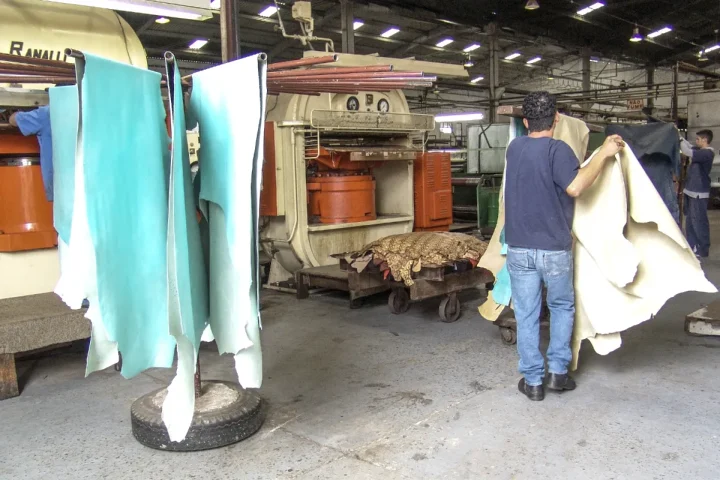
Being embedded in a welcoming community and working in the right atmosphere is part and parcel of retaining the craft of tanning and producing fine products using leather. We see it in France and Italy with the luxury goods industry. In the wider leather industry, the craft still applies as all leather produces goods designed to last, to be maintained, respected and appreciated – in many cases truly cherished.
One essential element that tends to be overlooked in this is group tacit knowledge. Group tacit knowledge is the “know-how” we find within the firm. We mostly think of business knowledge in leathermaking in terms of written formulas, percentages, temperatures, timings and drum speeds. This is explicit knowledge.
Not so long ago it was hard to get workers to write down the processes in full as the viewed knowledge as job protection. When training on the splitting machine in the 1960s, I was not allowed to get involved in the weekly cleaning; that was exclusively done by the chargehand and his son as it had been agreed with the unions that the son would inherit the job. My next encounter with a splitter was a couple of years later when I arrived in El Salvador. It was not an ancient lime splitter but a wonderful full width electronic Mercier sitting in its packaging with the staff afraid to even get it out of its box. You quickly realise the value of both explicit and tacit knowledge.
Difficult to articulate
Given that tacit knowledge is difficult to articulate or write down and is mostly learned through experience, observation, and practice group tacit knowledge is the “know-how” that’s embedded in a group’s culture and practices. It is the shared understanding, skills and insights that a group of people develop through working together over time.
Often it is seen as something only relevant to the old-fashioned approach, inappropriate for a modern engineered product produced perfectly to specification. It is certainly true that group tacit knowledge allows for the preservation and transmission of traditional techniques and best practices. It also requires a positive atmosphere to encourage the sharing of this knowledge, ensuring that it’s not lost.
For most businesses the codified knowledge, held in databases, is only a fraction of the know-how which almost every business employs. Even more so with a natural material with its special retained character. The past few years have put increasing pressure on tanneries to meet specifications, and often tannery technicians are primarily tasked with scaling up from small trials and maintaining the quality of the volume production. This has sometimes led to the technology really being owned by the chemical supplier.
With leather we should acknowledge that even in large, high volume tanneries, experienced tanners are also craft workers who develop an intuitive understanding of the natural attributes and their significance. This knowledge is passed down through apprenticeships, training, conversations and by example and shared within departments. It must not be ignored.
Golf shoes
I first met the power of group tacit knowledge when I could not understand why it took nearly a decade for Nike to make a decent golf shoe. Despite hiring staff from competitors, they could not build a shoe capable of handling the rigours of the stable shot plus the need to offer hours of comfortable walking. After ten years they pulled in an entire team of staff and retirees and made an older model to recreate a form of group tacit knowledge which they could then develop internally.
More recently I would point to Ecco Leather being the clearest example of a company that demonstrates strong Group Tacit Knowledge. It is a big organisation making large volumes of leather but from my first dealings with the business 25 years ago until today there exists a strong feeling for what makes an “Ecco Leather”. It means that as every hide is assessed and taken through the various tanneries with specific consideration for its qualities it is understand throughout the team and anyone of them knows when they have achieved a true “Ecco Leather”.
Surface characteristics, handle and other sensory aspects are all considered not just thickness but as cutting coefficients. This requires a very strong culture and is rooted in the flow of everyday activity, practice, application and learning. Established with facilitative leadership and reflective skills which in Ecco’s case came from Panos Mytaros who created the leather side of Ecco and gave the leathers the parameters they work with today. After some 30 years he left Ecco at the end of last year and they will be tested to maintain to maintain the group tacit knowledge which is so important in staying true to their culture and the higher quality products it brings.
Tanning, whether traditional vegetable tanning or modern automotive leather production, relies heavily on group tacit knowledge within tanneries and communities. While modern methods involve precise chemical formulations, much of the craft is still based on experience, intuition, and shared, often undocumented, expertise. Trouble shooting and final finishing are often key areas.
Group tacit knowledge also spreads beyond firms to communities, as we see throughout France and Italy, but could see further developed throughout the world of leather. This is not call to nostalgia but certainly to remember that, in using new tools of automation and AI, thought is required. So often we get reminded that an activity is deskilling when in fact it is adding value in an area where older methods are slow and inaccurate.
AI will not replace traditional craft work, but AI driven concepts can merge with human expertise to help tanners collaborate, compete and innovate, ensuring that the finest leather remains both technologically advanced and handcrafted. And avoids the commodity trap, while retaining the essence of place and craft which the consumer will appreciate for years to come.

Michael Redwood
Leather chemist, writer, and advisor on responsible leather manufacturing and material strategy. This article was originally written for ILM.