 Mike Redwood
September 10, 2025
Finding your identity
This summer has raised my sprits quite unexpectedly. For the second year, I was invited to join the judging for the RLSD Africa Showcase and more than I ever imagined I found it an utterly uplifting experience.
Judging in design competitions is not an area in which I am skilled. A glove design competition in London 30 years ago and a few years as a junior member of a distinguished team picking out new products at ISPO Brand New in Munich. Both were done in a day in person where it was easy to assess and compare thoughts about submissions together.
The RLSD Africa Showcase is different. It is an annual continental competition celebrating sustainability and creativity in leather design. It is part of the global RLSD campaign, a partnership between the Leather and Hide Council of America (LHCA) and the Africa Leather and Leather Products Institute (ALLPI), coordinated by the Centre for Business Innovation & Training (CBiT). The competition is superbly managed by the unflappable Beatrice Mwasi.
It encourages entries from designers, students and even small enterprises. The overall winner out of three categories – Apparel, Footwear Accessories – is named as the Most Commendable Designer and in the short history of the competition, this has become a coveted award.
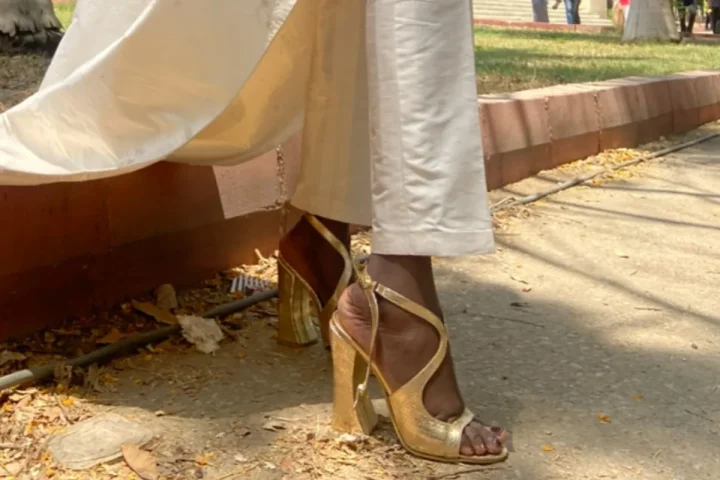
Farida Eid’s Serpent Sandal
This year’s winner was Farida Eid from Egypt and her winning design, the Serpent Sandal, carried Egypt’s history and culture into the contemporary world. It was a hard-fought win. Having come to understand the workings of the competition, a lot of the pleasure of being involved for a second year came from being able to spend more time examining all the entries in detail: and each submission is comprehensive.
RLSD is now well known for its design competitions around the world, but this African showcase feels different. It is uncovering a widespread cohort of young talent in the design and material sector across Africa and has the potential to set alight real growth in leather production and utilisation: putting together one of those raw to retail chains that are essential for Africa to grow.
Africa has history as a successful continent loaded with historic nations and peoples with immense skills and powerful cultures. All the entrants came across as fully aware and proud of this and knowing that it is the groundswell of youth that is the future of Africa rather than some miracle contribution from a foreign power. Current geopolitics only goes to confirm this, with AGOA coming to an end and China needing to maintain employment at home.
Building economies through exports is difficult, as all chosen partners remain keen on extracting raw, untouched or minimally treated. Inward manufacturing investment has had limited success.
Light industries and those such as leather with a large artisan content that cannot be replaced by robots or AI offer the jobs required by nations with growing populations and the pay-as-you-earn taxpaying employees that lay the foundations for a stable economy and with stronger institutions and less corruption.
Outside of Africa, we know about tanning centres such as Kano in Nigeria and Modjo in Ethiopia, both of which I first visited back in the 1980s, but the competition is uncovering a continent-wide network of schools and colleges teaching fashion, design, hands-on production skills, leather and materials. Every presentation showed remarkable understanding for leather, we watched many videos showing how the design was transformed into product and it was clear where each product would fit into the growing African consumer market.
I have heard it said that there are hopes the competition will become a movement toward ethical and sustainable fashion in Africa. It certainly does achieve some of its stated objectives:
- Elevates emerging talent across the continent;
- Fosters slow fashion through durable, natural materials;
- Provides real-world exposure, career-building opportunities and international visibility.
This latter point matters, as even the least experienced applicant is looking forward commercially towards personally creating a brand and future ranges of products. There is a section for commercial strength in the judging and when choosing a top design this could create tension if a design is more suited to the catwalk, making the judges look under the bonnet for the commercial direction. Some of the submissions were outstandingly commercial and are crying out for supporting angel funding to release them to much bigger things.
Their approach fits well with Cowan’s “consumption junction”, which puts the focus of such networked technologies and skills on the critical decision points where crafts must appeal to new consumers, respond to market changes and for the more substantial businesses, attract apprentices. This is how African leather evolving on this basis will win as it excites the human capital in its countries, uses domestic raw materials, builds on diverse regional cultures with great narratives and overlaps well with other material cultures such as textiles, which are needed to work alongside leather in many articles. It also continues the repair and zero waste structure that was the norm before the rush of the new global order; and yet it is still fit for the contemporary world.
A shoe can be a medium for cultural storytelling
Farida Eid demonstrated how a shoe can be a medium for thought, commentary, or cultural storytelling. She built upon her own studies exploring how footwear design has conveyed cultural meanings, symbolic messages and social functions throughout history. But she also highlights how Egypt’s unique visual and cultural elements in footwear have been gradually eroded—or transformed—by the forces of globalisation, raising questions about cultural preservation, adaptation and design authenticity in the modern era.
Her balance of ancient culture and the contemporary world was perfect, and while her articulation of the immense and diverse culture and history that could be lost in the commoditisation of Africa is outstanding, it was an underlying theme throughout.
Farida’s underlying beliefs in preserving history and craftmanship while contributing to modern society shine through in her design. The African leather industry still has an uphill battle ahead, but with more “Farida Eid’s” carrying the torch, we can be confident about the torchbearers that Africa needs.
As Most Commendable Designer 2025, Farida Eid will be travelling to Taipei to represent Africa at the RLSD International Showcase final. She is a superb ambassador for African design and leather. Through RLSD, African leather is finding its identity.

Michael Redwood
Leather chemist, writer, and advisor on responsible leather manufacturing and material strategy. This article was originally written for ILM.