 Mike Redwood
April 9, 2025
Every screen turned red
While at University back in the 1960s I was given a Little Red Book. “Quotations from Chairman Mao Tse-tung” was a pocket-sized compilation of excerpts from Mao’s speeches and writings, which Chinese citizens were required to carry. But quotes like “political power grows out of the barrel of a gun” were not easy to slip into student political conversations at the time, and unhelpful when I was canvassing for a Conservative Party candidate in the Huddersfield West constituency in the 1966 British General Election.
Mao’s Cultural Revolution (1966–76) was a mass mobilisation effort that encouraged young Red Guards to attack government officials plus intellectuals, teachers, and even party leaders. It led to widespread violence, destruction of historical artefacts, and upheaval in governance. Mao’s goal was ideological purification through class struggle, and it resulted in immense social and economic chaos.
The current U.S. government administration also sees itself as an anti-establishment insurrection which it is managing as a reality TV Show for the age of social media. The plan has undermined trust in institutions and fuelled political polarisation but has not yet resulted in state-backed mass persecution or a comparable cultural upheaval.
Both cases demonstrate challenges to democratic governance in different ways. The Cultural Revolution ensured Mao held unchecked power. The chaos and mass purges destroyed governance structures, making any return to democratic principles within the Chinese Communist Party impossible. The U.S. President’s attacks on institutions, including the judiciary, intelligence agencies, Universities and electoral processes all weaken democratic norms. So far this U.S. approach aligns more with historical examples of democratic erosion seen in places like Hungary, Turkey, or Russia than the total institutional collapse seen in China in 1966.
After Mao’s death Deng Xiaoping oversaw the rapid opening of China’s economy and from the mid 1980s onwards, I was privileged to travel regularly to China, often many times a year, until 2020. I observed China opening up, the economic transformation of the Pearl River Delta, the massive reduction in poverty as well as the big changes undertaken by Xi Jinping.
At the University of Bath, I had the opportunity to teach many Chinese business studies and international marketing students. Among these and many friends I made in China were some of the best relationships I have made in my career. People like Madam Zhang Shu Hua and Mr Su Chao Ying at the Chinese Leather Industry Association were outstanding representatives for China who fully participated in the global leather conversations.
It was clear that for many in China there was real appreciation for the rule of law, personal freedom, and science suggesting a preference for stable, rational governance over the chaos and ideological extremism that both Maoist radicalism and current populism elsewhere produce.
Every financial screen turned red
Yet on top of driving big changes domestically the U.S. administration then gave us “Liberation Day”. Over the following days every financial screen was solidly red.
The toughest aspect of the tariffs is the total unpredictability that surrounds them. It currently looks likely the universal 10% will remain but the higher figures will be adjusted if sufficiently large concessions can be gained to announce a “victory” of some sort. Yet promises made by Apple, Hyundai and the Taiwanese semiconductor industry appear to have made scant impact, but the cynical would say they did not come with enough theatre.
Given the breaking of the trade treaties signed in his first Presidency neither Canada nor Mexico will be confident about the lasting value of signing more. Especially so when the current position is accompanied by such disrespect and bullying.
Given the volatility of the situation, it is fruitless to go into detailed speculation at the moment, but there are some clear outcomes as we look forward.
- The U.S. has permanently damaged itself as a trusted partner in all types of negotiations, even beyond trade.
- It has broken from the rules-based international system (RBIS) it was central in establishing and leading after World War II. Its basis was the principle of national sovereignty and self-determination, and is a framework of political, legal, and economic rules, norms, and institutions that governs interactions between states to promote a fair, just, open, and predictable global order. These will now be reset, but we await to see who will be involved.
- The attack on small nations making low value-added goods such as footwear and clothing is particularly callous. We must hope brands involved support the employees there.
- It seems likely that there will be an impact on both the structure of the cheap throwaway fashion market and on consumer purchasing behaviour.
- The drastic termination of USAid internationally will do untold human harm, plus huge damage to America’s soft power.
- The reaction internationally towards Tesla and the backlash in Canada against all American goods is likely to expand to more countries.
- Supply chains will be adjusted, mostly simplified and shortened (regardless of final tariff levels) with specific supply lines established for the USA. New trade alliances will be formed, and others strengthened.
- Since these are tariffs on traded goods if countries adjust target markets, globalisation can continue with the U.S. excluded. The Ricardo theory of competitive advantage that countries should do what their skills and resources allow them to do best still remains valid.
- Contrary to being plundered as suggested by the U.S. administration, the U.S. has been a major beneficiary from globalisation. Western governments allowed deindustrialisation to happen too quickly and should have stopped the financial gains mostly going to owners and shareholders. That wealth was needed to support the abandoned “rust belt” communities. The dominance of concepts like shareholder value and private equity ignored important stakeholders and fed future problems.
- Global trade comes with the spread of technological innovation from which the USA may be excluded.
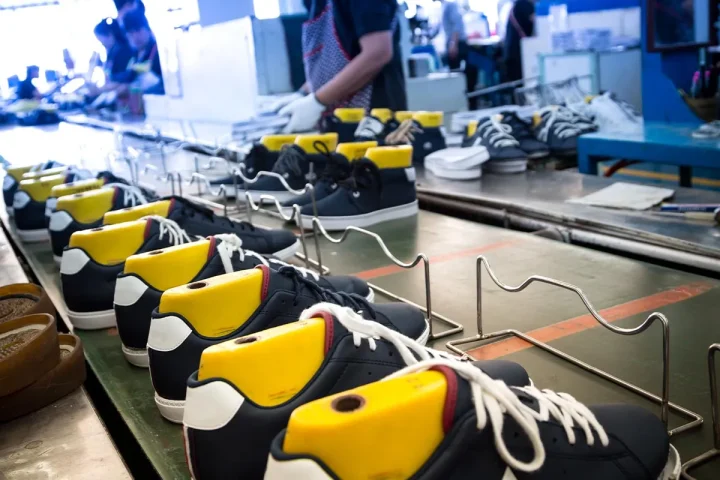
As well as disrupting existing supply chains, prices will rise for U.S. consumers, global economic growth will be damaged and leather industries in which U.S. hides play a key part as do U.S. consumers will struggle. It is hard to believe that the U.S. administration really wants to make its sneakers with American labour (US$22 or more an hour) rather than Vietnamese workers at US$4 an hour.
This is one to wait and watch as best you can, but in a soccer analogy, it currently looks like a spectacular own goal against the run of play.

Michael Redwood
Leather chemist, writer, and advisor on responsible leather manufacturing and material strategy. This article was originally written for ILM.