 Mike Redwood
May 28, 2025
Escaping the traps we set for ourselves
Countries, societies, industries and in particular leather are all finding themselves in disarray recently. But it is hard to find anything quite as worrisome as what is termed the Global Lexicon of Youth Despair.
This scary vocabulary covers economic futility, housing inaccessibility, mental health collapse and the rejection of traditional life paths. These areas are those that have historically provided the stability that routes us through education, work, home and family but are all crumbling when measured by the impact globally on 16–30-year-olds. Some of this I have already touched on earlier this year, but greater clarity came from an unexpected meeting while climbing to the battlements of the medieval Mont Orgueil Castle on the Island of Jersey a few days ago.
A discussion between my wife and I on 17th-century science and philosophy was overheard by a Macedonian Parliamentarian who wanted to support the philosophers. She was attending a conference on Jersey, and it was a delight to have an entertaining discussion with her; much easier than talking to the more opinionated politicians we occasionally come across elsewhere.
A major theme of her conference was the role of young adults in driving economic prosperity. I remain firmly of the view that economic prosperity itself has suffered from careless definitions of both economic growth and GDP which have led to the pursuit of false targets over the last couple of generations.
This is coming clear among 16–30-year-olds through terms like “gig economy”, “neijuan”, “parasite singles” in Japan, “quiet quitting”, “boreout” in France, “Ubträndhet” burnout in Sweden and many more. A true vocabulary of youth despair.
A society that can no longer evolve
In a world which we promised ourselves that mechanisation, automation and invention would make life easier and better, we now have a 16–30 age group mental health crisis, young people opting out or feeling suicidal; and crying out that they have no role to play in “driving economic prosperity”. In fact, the very word “neijuan” is a Chinese term, roughly translated as “involution”, that describes a state of intense competition and pressure within a group where individuals are constantly trying to improve themselves or their work, working long hours and competing fiercely, yet those efforts do not lead to real advancement or improved well-being. Shockingly, it is also applied to a society that can no longer evolve, no matter how hard it tries.
How do we resolve this situation for the planet and the young? It is now clear that for 16–30-year-olds in much of the world, governments have been miscalculating the sort of jobs needed as well as the education required and have ended up with an enormous mismatch. Youth unemployment in China soared above 20% before the figures stopped being published, and the reason was largely because the promised jobs for graduates did not materialise after the government decided to attack the very private businesses needed to provide them.
Underemployment and young workers doing jobs below their education level stretch far beyond China. Forced to do nothing or “eat dirt” as suggested by the Chinese Premier, around the world young people too often can find only precarious, short-term contracts and low-paid service jobs. Given the promises previously made, they find themselves with graduate debt and zero or low returns for their education, plus everywhere reminders that Artificial Intelligence will eliminate entry-level employment.
It is no surprise to see a major mental health crisis added to this mix. This is affecting a wide range of countries and socioeconomic groups, with young people reporting record-high levels of anxiety, depression and burnout.
High unemployment
Beyond China, youth unemployment is high in Italy, Spain and Greece. Great Britain is panicking about high numbers not in education, training or work, and in Sub-Saharan Africa high numbers of educated young people face informal work and underemployment.
It is clear that governments and companies must start to arrange mental health services in business, schools, universities, and community services. Housing and wage policy must advance to offer young people a sense of security, and education changes must properly align with real-world skills and consider the whole complex area of emotional resilience.
Much of this latter arises via social media pressures and comparison culture, to which add climate anxiety and global instability plus the trauma of the pandemic with its disruption of social and educational development. We all had pressures of sorts when we were young, but these are at a different scale. Parents, communities and governments are struggling to cope.
Currently a lot of job creation is focused on green industries, the care economy and digital public infrastructure. In different ways, all three sectors are meaningful to the young through their intrinsic value, flexible work structures, civic pride or a less exploitative work environment (for example compared with working for big technology companies).
Leather fits into the green industries
Leather fits perfectly into the green industries as an extension of regenerative agriculture and a full participant in the circular economy, which requires avoiding waste and making things which last longer, can be repaired and reused, and are easily and safely managed at end of life.
Africa has the fastest-growing youth population in the world, and livestock management, leather tanning and the design and production of goods from leather offer livelihoods rooted in land and community, reducing migration stress and feelings of dislocation. Stopping the unnecessary loss of unprocessed or semi-processed raw means plentiful jobs fit into a structure combating eco-anxiety by giving youth a role in protecting their environment.
In India, we see a massive youth population facing a jobless growth paradox, with automation and AI threatening routine clerical and IT jobs, allied to skyrocketing rates of student stress, exam anxiety, and youth suicide. The Mahatma Gandhi National Rural Employment Guarantee Act (MGNREGA) includes livestock management, specifically through activities related to livestock housing, feed and fodder availability, and water resource, and should be used to restructure the raw material supply to tanneries in a much better coordinated way. Proper pasture management will retain moisture in the soils and help fight climate change. Leather is already a major earner in Indian exports and should look forward to big domestic growth in the world’s most populated economy.
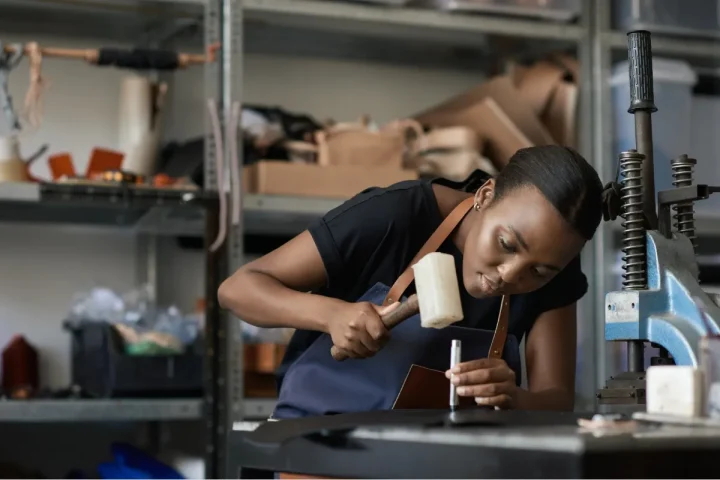
Leather itself involves such roles as sorting, fleshing, shaving, tanning and finishing in the tanneries, plus patternmaking, cutting, stitching and polishing in product making. All these and the many other stages require manual skill and experience, and historically these were high-skill artisanal jobs – but as discussed in previous weeks, industrialisation has often reduced them to low-paid, hazardous work. Deskilling the workforce, separating out the creative satisfaction and allowing workers to be replaceable and underpaid is part of a global malaise. Governments may promise good jobs, but if the leather supply chain gets together to sort things out, we have them in large numbers. But this requires determined battles from farm to retail, and the full support of suppliers and other stakeholders.
As the leather industry looks around, we have seen that cleaner work reduces health risks and stigma, and that when upgraded properly, tanneries can run on low emissions and with good labour standards, as is already happening in Europe and parts of Asia. On top of this, craftsmanship is more valued today than for many years and artisanal hand-crafted leather goods (e.g. shoes, bags, saddlery, bookbinding) can offer stable, skill-based employment.
We see this in the workshops of France and Italy and can imagine this being emulated in locations such as Fez and wider Morocco with a change in mindset, and in Tamil Nadu’s footwear clusters, along with a myriad of other locations. This can run from luxury to everyday use, but we must never let leather slide to the bottom. Leather in consumer hands is a long-lasting friend, not a commodity. Every worker in the chain from start to finish deserves a proper income.
We should recognise our responsibility to offer youth jobs with dignity – not drudgery. In general, craft jobs provide that when supported with correctly considered health and safety, PPE, waste management, in-work training opportunities and reasonable pay.
But it requires a shift from volume to value, from raw exports to branded craftsmanship, and to ensure every tannery offers clean, responsible production. This, allied to proper investment in training, design, and community involvement, is key to making this next transition youth friendly.
Such a shift allows the industry to reclaim leather as a good future working environment, a place full of properly paid jobs. As such we must
- Rebuild leather’s status as a skilled, valuable profession
- Recognise and support regional craftsmanship (e.g. Ethiopian, European, Moroccan, Turkish, Indian or Chinese)
- Shift from mass low-cost goods to branded, traceable, sustainable products.
In such an environment, our youth can find fine jobs in production, technology, material science, fashion, design, and sustainability within leather and can drive a wider transformation.
I cannot pretend that we can solve the world’s problems, but I do believe that distilled down this approach creates far more routes to save the leather industry from its apparently determined decline. It is certainly better than spending our past year complaining about plastics and praying for an effective influencer.

Michael Redwood
Leather chemist, writer, and advisor on responsible leather manufacturing and material strategy. This article was originally written for ILM.