 Mike Redwood
June 24, 2025
Counting Scottish cattle
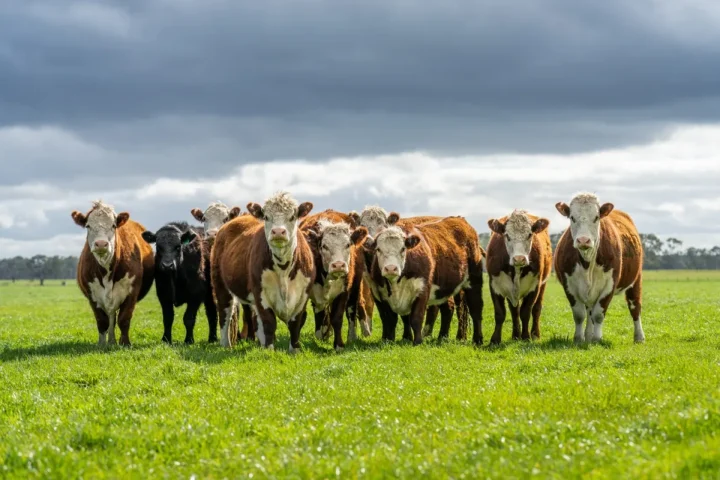
This is an important moment for cattle – or, more accurately, livestock such as cattle and sheep. A group of scientists complained via a well-publicised letter to newspapers that a push by New Zealand and Ireland to get GWP* used to measure livestock emissions, rather than the older GWP100, was an abuse intended only to allow them to increase herd size.
For those of you who did not visit the Royal Highland Show in Scotland last week, you may have missed the Scottish government’s decision to reject recommendations from the UK Climate Change Committee (CCC) that Scotland cut its livestock herds by 27% by 2040 for net-zero targets; they would hit the targets by other means.
They said: “The Scottish government is absolutely clear we will reach net-zero in a way which works for rural Scotland and plays to our strengths. That means we will continue to support our livestock sector to reduce emissions. There is no policy to reduce livestock numbers.”
From a leather industry point of view, we congratulate the forward-thinking of the Scottish government and, in looking at New Zealand and Ireland, ensure that we all fully understand the true significance of the GWP debate. The way GWP is calculated is important.
GWP calculations
GWP* was developed by climate scientists at the Oxford Martin School, Oxford University, looking for a better metric for short-lived greenhouse gases, particularly methane. Methane has a strong but short-lived warming effect over 10 to 12 years in the atmosphere, while CO₂ persists for centuries. The Greenhouse Warming Potential (GWP100) puts a multiple on methane to make it equivalent to carbon dioxide (CO₂), which persists in the atmosphere indefinitely.
Since the GWP100 calculation overstates methane’s long-term impact, they felt it was misleading climate policy – especially for sectors such as livestock agriculture. GWP* represents how changes in methane emissions affect global temperatures by linking methane emissions to their actual contribution to warming.
While cumulative emissions are important for CO₂ (the latest examination suggests only three years of current CO₂ at the current 40 billion tonnes a year before the Paris 1.5°C figure will be breached), for limited-life chemicals like methane, calculating emission rate changes rather than cumulative emissions makes more sense.
Both Ireland and New Zealand still use GWP100 but are reported to be arguing for a change that includes the recognition of biogenic methane as different from that emitted from coal and gas extraction or municipal waste dumps. This approach certainly involves a level of self-interest, but it is backed by a lot of sound science, including the team at the University of California, Davis (UC Davis).
In an online article in 2022, Davis wrote: “GWP* clearly shows that livestock, as members of the biogenic carbon cycle, can eventually become climate neutral and no longer actively contribute to warming if the proper interventions are taken to curb emissions along the supply chain.” They argue that their own work in California has already successfully demonstrated that livestock methane can be reduced without reductions in animal numbers.
The Scottish position
Scotland is not fighting a battle about how to measure methane, but more a residual belief that seems to have started with the 20-year-old FAO error-loaded paper Livestock’s Long Shadow. This paper was both discredited and later partially corrected, but like CO₂ it persists.
In rejecting demands to cut livestock, it suggests it will still achieve these targets by techniques such as methane-reducing feedstocks. In California, enhanced nutrition, genetics and animal care have all played a part. Where relevant, anaerobic digesters are used to capture methane from manure.
The Scottish approach is better, trying to integrate an understanding of food production, nature, and the livelihoods and survival of rural communities.
For many years, the beef sector in Scotland has suggested that its largely regenerative approach was already near neutral when grassland carbon sequestration was taken into account. Travelling north and to the islands, the importance of livestock – in the correct numbers – to maintain the beautiful flower and invertebrate-rich machair grasslands becomes clear. They are also major breeding grounds for now rare iconic birds like curlew and corncrakes.
Such pasture-based systems are, for many, the future for livestock. It makes little sense for the UK to cut herds and yet import large amounts of beef with a much larger carbon footprint, especially when recent breakdowns in global supply chains have raised issues of food security.
In fact, given the speed with which weather patterns are changing as a result of climate change, Scotland, Ireland and New Zealand – all with hilly, rocky, peaty or unique grasslands – look likely to be among very few nations specifically suited for livestock, where it will remain possible for animals to live safely without heat stress or drought issues.
As tanners, we must support such countries in their efforts and ensure no hides or skins go to waste.
References
Allen, M.R., et al. (2018). “A solution to the misrepresentations of CO₂-equivalent emissions of short-lived climate pollutants under ambitious mitigation.” Climate and Atmospheric Science.
Cain, M., et al. (2019). “Improved calculation of warming-equivalent emissions for short-lived climate pollutants.” Climate and Atmospheric Science.
Rocha, A. M. (2022, 18 May). GWP — A better way of measuring methane and how it impacts global temperatures*. CLEAR Center. Retrieved 24 June 2025, from https://clear.ucdavis.edu/explainers/gwp-star-better-way-measuring-methane-and-how-it-impacts-global-temperatures

Michael Redwood
Leather chemist, writer, and advisor on responsible leather manufacturing and material strategy. This article was originally written for ILM.