 Mike Redwood
Circular Materials: working together
 With Huub van Beijeren (centre), then CEO of Stahl and Prof Ferdinand Dudenhöffer (right) in September 2015
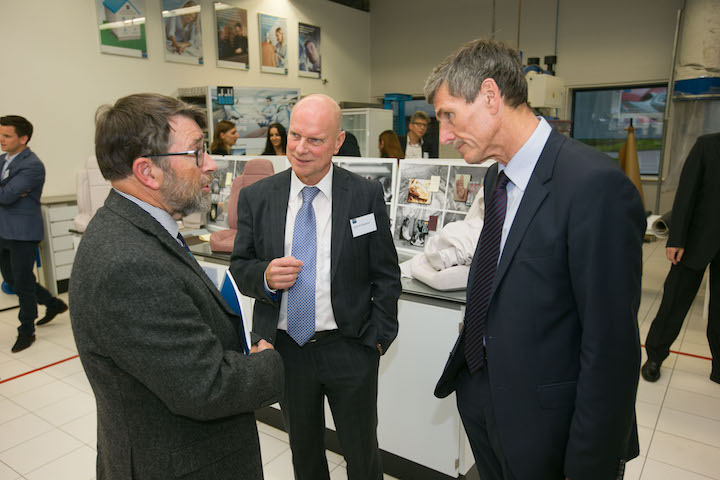 With Huub van Beijeren (centre), then CEO of Stahl and Prof Ferdinand Dudenhöffer (right) in September 2015
As of September 2025 I am changing this section to bring together thoughts on the Circular Economy and circular materials of which leather is only one. I have long argued that natural materials have suffered as the result as the result of heavy lobbying, misunderstood science and an arrogant (or is it fearful) leather industry that believed using marketing to protect market share and improve position was an unnecessary expense, indeed potentially harmful. All hides and skins collected were being made into leather and supporting leather would just provide a target for prejudiced attack by the more extreme vegan and animal rights groups.
Today the LHCA in America say that 40% of our raw material is thrown away as alternates have taken its place. I the last decade the leather industry has geared itself up to attack biomaterials that pass themselves off as leather. Misleading the consumer with false claims and the misuse of the term leather is wrong, but they have taken almost zero market share, What has happened is a big increase in the use of fossil fuel based synthetics built on plastic monomers – they have greatly improved and designers have got better at using them.
But the problems with plastic are now becoming understood – difficult to recycle, biodegradability issues and increasing worry over microplastics. When we get most of the 40% of wasted raw material back into leather the reduction in plastic use in materials will not be that huge; to make a difference leather needs to work with the best biomaterials and hybrids. I want this section to now focus on that area.
I start with a long quotation from the 62nd John Arthur Wilson I gave to the American Leather Chemists Association in 2023.
“The argument that more fundamental research is required in the leather industry to stay ahead of competitive offerings flows into the subject of biomaterials where large amounts of finance have been steadily put into research for much of this century.
We know from history that leather is accustomed to changing end-uses as new materials such as glass, paper and textiles come along, but none has made greater inroads than the plastic polymers derived from coal and oil, creating the generic term of synthetics.
The structure of the livestock industry has meant that meeting the demands of a growing population does not lead to an increase in long-term per capita availability of leather. Fewer but larger animals, greater efficiency in raising milk yields and greater consumption of white meat like poultry all mean that the growth of leather production has been very low for decades.
The simple fact that no one keeps livestock for leather has been obvious throughout the last 100 years and was the major driver for another sixties event – the 1963 announcement by Du Pont that their new material called Corfam that was going to replace leather.
There had been a host of materials such as vinyl, leatherette and leathercloth offering low-cost coverings for books and boxes made to look superficially like leather, but this was the first carefully constructed poromeric material designed with the performance hoping to match leather.
Corfam failed with amazing speed. No one who bought a first pair ever bought a second. They were too uncomfortable. Corfam was expensive to produce and shiny so put into the more formal footwear category. These were the shoes of the office and the commute where foot comfort mattered.
Apart from creating a textbook marketing disaster Corfam showed how difficult it is to copy leather and how necessary it is to understand how consumers perceive complex subjects such as comfort. In his book in 1924 Wilson uses his entire final chapter to analyse consumer research comparing vegetable and chromium tanned leather, routinely returning to the laboratory for further work so that the results had meaning for future progress in leather making and offering practical suggestions to improve comfort.
Instead, the synthetics industry found other routes into the materials covering markets by offering good properties at low prices, in a route well described by Christensen in the Innovators Dilemma[ii]. This was aided by the arrival of sneakers which certainly helped the split market while giving exposure to a better generation of synthetic materials that could be combined with leather and textiles to make attractive, comfortable footwear. At that time little mention was made that sneakers were never repaired. These synthetics then relentlessly grew market share in all areas.
This century synthetics gained ground every time raw materials rose in price without retreating in the way they have previously when prices fell. Their growth in share in footwear alarmed the leather industry who objected to their positioning and claims. Several recent JAW Lectures have discussed this point in detail, in particular Gustavo Gonzalez-Quijano in the 60th Lecture
The good qualities that made plastic essential to 20th century life have been tarnished by critical failings that impact climate change and rapid loss of biodiversity. We should remind ourselves of them:
- They are based on fossil fuels.
- Their useful life is very short and they cannot be repaired
- They shed or degrade into microparticles in ways not previously understood, in particularly in salt water.
- In landfill the plastic element will take between 500 and a million years to biodegrade
- They are very hard to satisfactorily recycle.
It is not leather that needs replacing but all these plastic materials. Since there can never be enough leather to fill the gap then biomaterials are the best bet to move into the immense space held currently by Petro-fibres of all types.
Leather has proven difficult to match and we have seen a decade of failure. Currently only Piñatex, a cellulosic non-woven derived from the discarded leaves of pineapples appears to have reached bulk and it has a very distinct aesthetic unlike leather. A mycelium production can be expected in 2024 and there will be another presentation during this convention. What is obvious is that before long the gap will be jumped and my argument would be to not designate biomaterials as enemies of leather but potential partners.
So let me be quite clear that I support the development of biomaterials and think it right that the leather industry should increase the collaboration that has already begun. If we engage with them and share expertise I am confident we have the combined skills to create the best portfolio of materials originating essentially from nature.
I do want to declare an interest as I have given some advice to companies in the sector based on my belief that we need good materials to fight the plastics and to give vegans a better plastic free offering.
Before we go further let me also address a related matter. When people sell something which they say is essentially biobased they need to be honest and transparent about it. The discovery by shoemakers confirmed by laboratory tests at FILK that many have close to 50% polyurethane demonstrates a level of deceitfulness. It is nothing to do with marketing. Similarly saying that cows are saved from slaughter by not buying is not marketing either, it is a lie. These are areas, along with that of the accurate description of leather, where we must support our national associations to improve the laws and put more effort into enforcing existing laws.
We should remember that while bioplastics are a major improvement on fossil fuel plastics they are still plastic, so the longevity in use and end of life issues still exist. This can be a problem for leather as well as biomaterials. Some heavily coated leathers are not much better than many biomaterials[v]. Perhaps tanners should revisit linseed oil and other such materials that were used to make patent leather before the age of plastics.
I also believe that amongst the best biomaterial producers there is full commitment, along with the necessary research funding, to complete the journey to a fully-fledged material suited to work alongside leather. The sector, like tanning, has its charlatans but most are well intentioned.
I now want to return the discussion to our raw material by quoting a few lines from a recent book by the Scottish writer and poet Kathleen Jamie writing after she visited ancient cave paintings of horses, cattle and other animals in Spain:
“There was a time – until very recently in the scheme of things – when there no wild animals, because every animal was wild; and humans were few. Animals and animal presence over us and around us. Over every horizon, animals. Their skins clothing our skins, their fats in our lamps, their bladders to carry water, meat when we could get it.”
Kathleen Jamie, Sightlines
I have been a Trustee of the UK Leather Conservation Centre since 2005 and this quote came up when we did a recent residential course for international conservators and curators. Archaeologists the world over are looking in new ways at how humans and their predecessors have made use of hides and skins for most of the last two million years.
Because of global warming artefacts that have been buried without air for thousands of years are now coming to the surface. Work done by the Leather Conservation Centre and others has made it possible for these to be properly conserved and available for study.
The work highlights the successful use of hides and skins by humans in every state from raw onwards. Hides and skins which are totally raw, parchment pure or sometimes adjusted with small vegetable material, hides treated with “leathering” oils, and then brain and smoke, alum, vegetable tanning and full oil processing. Many with no or minimal treatment functioned perfectly well in the prevailing conditions.
When Rawasami gave this lecture in 2001 and searched for Wilson’s dream of a unified definition of tanning he looked at measures such as shrinkage temperature and structural stabilisation amongst other more complex ideas. Later Eleanor Brown suggested that tanning might be better viewed in terms of protein modification than as simple crosslinking, hence the term of stabilisation of the collagen structure I previously used is copied from recent correspondence with the Director at the New Zealand Leather and Shoe Research Association.
Rawasami put it simply that In the “new material world, leather needs to perform. While mankind has striven to design and make materials with similar molecular assemblies and network structures, Nature has provided the leather chemist with an architectural marvel in the form of skin. ……. Skin encompasses in its architecture a vast array of ordered structures.”
Underpinning Wilson’s work and so many JAW lectures is this collagen structure – its architecture as much as its chemistry. Tanners do not make leather through assembly or synthesis. They do it through conditioning, that is making changes to the material to make it fit for purpose. With hides and skins that is usually best achieved by doing as little as possible
Some raw material grades can push us too far towards a commodity. Might it not be better while looking for new ways to stabilise collagen as leather to use some collagen for other purposes altogether?
Back in the 1980s the late Bob Higham and I started an abortive attempt to look at whether the bottom 10 per cent of hides and skins could be taken for leather making and used in other ways. The project did not go far as those already using hides and skins for products like casings wanted to avoid scar tissue. But times have changed, technology has advanced and the economics have changed.
Currently we have unwanted hides and skins being thrown away, and a way needs to be found to get them back into the chain, but should every hide and every skin end up as leather?
The idea of collaborative working in this area of chemistry and architecture would appear to offer great opportunities to the material world for those trying to work to the best use of all hides and leather and advanced biomaterials.
New leathers and biomaterials must consider Circularity. Braungart and McDonough’s 2002 book Cradle to Cradle puts great emphasis on post end of life treatment as the prime objective. This does not so makr sense for leather where longevity matters so much.
The main concept behind the Circular Economy comes from Walter Stahel’s Mitchell Prize winning paper in 1982. He argues that we need to keep goods longer and repair them. His Product Life Extension concept, now sometimes called the Value Retention Process, says we should make articles that last for longer and consumers will want to keep. Using resources for the longest time possible and then repairing and refurbishing them would reduce emissions and the new materials consumed. “A new relationship with our goods and materials would save resources and energy and create local jobs” Stahel has since been working with the Ellen MacArthur Foundation and has updated his thinking in several books and in a 2016 article in Nature.
Stahel’s paper feels as though it was written with leather in mind. Not all items that the Leather Conservation Centre conserves suddenly appear as glaciers shrink and permafrost melts. Most are centuries old items that have been well used and kept. Many items like drinking vessels carry initials to show they have passed through generations. Wall coverings last for centuries and the UK has four original copies of the Magna Carta.
In recent years a remarkable effort has been put in to reduce the footprint of leather in terms of water, energy, chemicals and all types of waste. Wilson wanted well managed waste, even in the 1920s. He gave the Chandler Lecture for 1928 when he was the director of research for the Milwaukee Sewerage Commission as well as Chief Chemist at Gallun. His citation said that he made major improvements to the “sewage disposal plant for his own city of half a million people which is a valuable object lesson for all our cities but has made it operable in such a way that it may soon be returning revenues to the city”.
The work and the associated investment by most tanneries in all environmental areas has been large and consistent. As an industry we can now honestly say that we go beyond merely complying with legislative demands and are searching out levels of best practice that allow us to face the world of materials with some pride. We have tanneries and organisations that have completed their own Life Cycle Analysis and as well as using them with key accounts have made them public. This has been in stark contrast to the Higg Index, now rebranded Worldly, whose opaqueness led to its own downfall, after many years of doing great harm to natural materials and especially leather.
A collaboration with biomaterials that supported all these objectives would mean that centuries of building product knowledge, process knowledge, market knowledge and our historic understanding of the Circular Economy can be usefully applied in an overlapping area. I believe such a move can offer major growth to our industry and unlock research funding and creative thinking. It can work to push plastics out and make a significant difference to the linear disposable consumer attitude in fashion, lifestyle and elsewhere. Together we need to change the consumer relationship with products.
Kanigel, Robert Faux Real: genuine leather and 200 years of inspired fakes Joseph Henry Press, Washington DC,
Christensen, Clayton M. The Innovator’s Dilemma: When New Technologies Cause Great Firms to Fail. Boston, MA: Harvard Business School Press, 1997.
Gonzalez-Quijano G. The 60th John Arthur Wilson memorial lecture: a future for leather! J Am Leather Chem Assoc. 2019;114:244–55.
Meyer, M.; Dietrich, S.; Schulz, H.; Mondschein, A. Comparison of the Technical Performance of Leather, Artificial Leather, and Trendy Alternatives. Coatings 2021, 11, 226. https://doi.org/10.3390/coatings11020226
Carcione, F.; Defeo, G.A.; Galli, I.; Bartalini, S.; Mazzotti, D. Material Circularity: A Novel Method for Biobased Carbon Quantification of Leather, Artificial Leather, and Trendy Alternatives. Coatings2023,13,892. https:// doi.org/10.3390/coatings13050892kk
Ramasami, T.; Approach towards a unified theory for tanning: Wilson’s dream. JALCA 96, 290-304, 2001
Brown, E.M COLLAGEN – A NATURAL SCAFFOLD FOR BIOLOGY AND ENGINEERING. ]ALCA, VOL. 104,2009
McDonough, William. and Michael Braungart. Cradle to Cradle: Remaking the Way We Make Things. New York, North Point Press, 2002.
Stahel, W.R., 1982, The product life factor. An Inquiry into the Nature of Sustainable Societies: The Role of the Private Sector, Houston Area Research Center, 1982
Stahel, W. The circular economy. Nature 531, 435–438 (2016). https://doi.org/10.1038/531435a
Wilson, J.A. Chemistry and Leather, Chandler Lecture for 1928 INDUSTRIAL AND ENGINEERING CHEMISTRY Vol. 21, No. 2, 1929
My regular thoughts on this and about the trade in general are to be found in my weekly articles published under the Opinion section of International Leather Magazine This has been running since 2013 so there is a lot to read. The “blog” items here are less regular and not intended to be so timely although I have now added in those I did for the University of Northampton from 2007 until 2018, since their site became insecure. If you look elsewhere on the International Leather Maker site you will find some more articles from each year that went into the printed magazine. Over the next few months I intend to place some of the items from ILM into my blog section and in this section.
Beyond that I have written for La Conceria magazine, Leather International, and APLF so items can be looked for there. I was involved in editing World Leather, World Footwear and World Sports Activewear for a few years until 2007 but we did not add any names to many articles. I will selectively also be adding some of these to make this site more of a comprehensive source for my views.
Below I have added a mix of articles, academic papers, podcasts, and webinars. For those items with no link they are often lectures where I have not made a recording – I rarely use notes. Otherwise I will steadily try and add the full text as and when. Email me via the contact if you would like to know more.
APLF Academy: The Leather Industry in the Corona Era
April 2021. My personal thoughts on how COVID-19 has and will continue to impact the industry. https://www.youtube.com/watch?v=3bQ7D-4mheI&t=141s
APLF Academy: The Future of Leather
April 2021. I had the opportunity to interview Jon Clark and Fernando Bellese of Prime Asia on how they saw the future course of the leather industry most of whose thoughts have been accelerated by the Pandemic rather than slowed. https://www.youtube.com/watch?v=RHGpA2pdwGM&t=34s
Mike Redwood Podcast Interview Totally Leathered – Leather Repair Company
I was interviewed by the Leather Repair Company in May 2021. It is a long conversation but was fun to do and a lot of my ideas about leather come across https://www.youtube.com/watch?v=toX9H_ecT8o
Leather: its culture, history and relevance today – Mike Redwood
In a very hot New York at the World Leather Congress in midsummer 2019 I rather stumbled through this talk the day after spending time in the famous Swamp tanning area set up in New York between what is now Wall Street and the Brooklyn Bridge. This is where Julius Kuttner, the North American Manager of Booth and Co. and August Schultz met to discuss making a leather which would not stain ladies corsets at lunch at Racky’s restaurant on Frankfort Street and commercial chromium tanning was set in motion. https://www.youtube.com/watch?v=YCCVUBlEGEY
Mike Redwood on Leather Market Share2
I rambled on uninterrupted in this September 2016 interview with HideNet but the points in this short video have proven true. Remember this was before we started seeing sheepskins being thrown away around the world and then hides being buried or burnt in the US, both of which have now become a feature. https://www.youtube.com/watch?v=lRrWA-JkjNg&t=143s
APLF Webinar: Why leather should not be purely for the luxury market
From February 2014, but still quite relevant nearly a decade on https://www.youtube.com/watch?v=EEe0EAOlPZA&t=247s
In much of my career I have worked in companies and sectors that have had an unusual view of marketing or openly opposed it. Clear exceptions would be ADOC, FootJoy (Acushnet) and ECCO where their great marketing skills taught me a lot. Increasingly through the 21st century marketing has become better utilised, even if not better understood, and much easier to discuss than ever in the past.
Most of all when we work in an industrial area with products that are going to be sold on a business to business basis the producer company retains an orientation very much towards the product. One that says “this is what the product is like, and therefore you must accept what it is and take it more or less like this”. In older times when consumers had less knowledge and less choice this was often successful. Rarely will it succeed in the modern world.
The opening picture was taken in late 2015 in Waalwijk, in the Netherlands. I was delighted to be invited to the Stahl Chemical HQ for the opening of their Automotive Centre and the picture shows me with Huub van Beijeren, CEO of Stahl (centre) and Prof Ferdinand Dudenhöffer of the University of Duisburg-Essen on the right. I like to watch the automotive industry carefully as strategic developments in the industry tell us a lot about the big trends evolving in society that all marketers must watch. It both drives and is driven by the megatrends.
Simplistic approaches are also common. Taking an item like leather and explaining it away as a “component branding” is far too easy as its role as a component varies hugely with end product. Sometime it is “merely” a component but often it is the only component or only significant component and clicking into a historical or text book ingredient branding mode will create all sorts of issues. Also the separation of business to consumer and business to business does not fit with modern times. The concept of Service Dominant Logic and the workings of networks in business (the ones I studied for my Bath PhD rather than the wine and chat one pictured with Huub and Professor Dudenhöffer, although they play an important role – rather Schultz’s ideas for his chrome patents were formulated in a casual New York luncheon meeting) have meant that a form of direct to consumer marketing has becoming closer. Where the consumer sees the value, and how that is accessed is ever more important, and the 2020-21 COVID-19 pandemic has pushed that to the fore as retail shops were forced to closed. This was a trend already happening and many did not survive so D2C, direct to consumer, has taken over even in the leather world as a serious part of the business.
Equally identifying the role of strategy within branding, the increasing dominance of the brand and the ever changing consumer is vital. What now gets termed as “post modern” marketing where the consumer uses the brand to express individuality or where they want to be in society, and thus plays a role in defining the brand has become a vital element. The concept that management can control the brand and manage it via the 4Ps is less and less true. Areas like Service Dominant logic, and understanding the dynamics of business networks are again vital in being successful.
My area has been in strategy, and strategy in selected segments in a global environment. I look a lot at business from a network perspective and this defines the way I have looked at the Booth Group (on which you will find a full separate section on this website).
To keep up to date with my thinking read my articles on APLF https://www.aplf.com/en-US/leather-fashion-news-and-blog/blog, ARSTannery https://tannerymagazine.com and most frequently International Leather Maker, and my Blogs in ILM They are nearly all partially in support of the Leather Naturally programme but usually talk about it from the marketing perspective.
Below are some things I have written, with the more academic first:
Redwood M (2013) Corporate Social Responsibility and the Carbon Footprint of Leather. Journal of the Society of Leather Technologists and Chemists. 97(2):47-55 Corporate social responsibility
Redwood M & Ford D (2012) The Role of a Single Actor in Technical Innovation and Network Evolution: an Historical Analysis of the Leather Network Journal of Customer Behaviour. 11(2):181-196. DOI:10.1362/147539212X13420906144750
Redwood M. (2008) The challenges of the leather industry: Wolstenholme Memorial Lecture, Journal of the Society of Leather Technologists and Chemists 92(2): 47-52 DOI: N/AWolstenholmeLecture-redwood
Ford D & Redwood M. (2005) Making sense of network dynamics through network pictures: a longitudinal case study Industrial Marketing Management. 34(7): 648-657 DOI: 10.1016/j.indmarman.2005.05.008 Making sense of network dynamics through network pictures
Ford D & Redwood M. (2005) Managing Technology in Complex Networks Journal of the American Leather Chemists Association 100(3): 93-101
Going further with the Yak – Leather International
The Challenges and Opportunities ahead for European Tanners and their workforce as the opening paper for the EU Social Dialogue programme Objective 2025. Presented Bucharest April 2015 Cotance Bucharest final
Managing Public Relations in the Face of Attacks and Misdescriptions The Leather Forum, APLF, Hong Kong, March 2015
Who needs a car when we all live in cities? ILM automotive supply chain Conference, Shanghai, September 2014
The Significance of Good Science in Marketing JALCA Keynote talk, New York, June 2014
FILK Germany Keynote 2013 Extracting the True Value from Leather: a Marketing Approach
ISPO Sport show Munich Traceability in Leather 2014 (public lecture to European Outdoor Group members)
World Leather Congress, Branding and Marketing Rio, Brazil 2012
Cradle-to-Cradle Manufacturing Innovex (Innovations for extremes conference) 2011, University of Lancaster
Prime Source Forum HK 2012. “This House believes that countries like Bangladesh, Vietnam and Sri Lanka will soon displace China as a desirable region for sourcing textiles” proposed by Mike Redwood, and opposed by Tom Nelson, SVP and MD Asia of VF Corporation.
Asian Leather Chemists Conference, Carbon Foot printing & Corporate Social Responsibility Taipei November 2012
The Role of Ingredient Branding, Textile Institute Conference, 2013
Globalisation BASF Global Campus Session Keynote, Suzhou, China
Where is the Consumer value, Automotive Conference, Shanghai, 2012
How consumer power is defining activity in the tannery, presented at the Textile Institute Centenary Conference in Manchester.2011
Educating the Consumer, COUROMODA & CICB, Sao Paolo 2011
Strategic Plan for the Pakistan Leather Industry, commissioned by the Ministry of Light Industry (done with the late Dr Warren Weinstein) Finalised 2010
Future Trends and Expected Status of the Leather Industry Keynote Speech at the XVII UITIC Annual Conference, Leon, Mexico, also presented to the 17th UNIDO Leather and Leather Products Industry Panel, Addis Ababa 2010
Future Trends and Expected Status of the Industry to 2030 was a paper I co-wrote for UNIDO, completed in 2010

Michael Redwood
Leather chemist, writer, and advisor on responsible leather manufacturing and material strategy.