 Mike Redwood
June 10, 2025
A captivating dinner in London
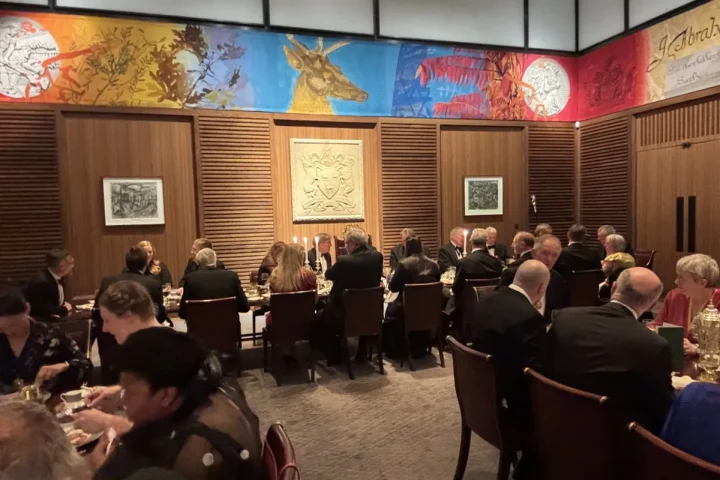
At a black-tie Leather Industry Dinner hosted by the Worshipful Company of Leathersellers of London last week, I was delighted to pass the port to my neighbour on the left (by tradition derived from the British Navy the port decanter is always moved to the left – port to port). Leathersellers have been having such dinners for well over 600 years, so you might think there was nothing to see. You would be wrong.
The attendance was not the standard concentration of middle-aged men but a major shift younger with well over a third being women. It was no longer a single leather sector protecting itself but involved guests from many livery companies with connections to leather (hence so many elderly men).
Trades have always had associations. By Ancient Roman times (when high quality leather was vital for the military to control their expansive Empire), tanners were formed into a collegium and these became semi-hereditary guilds or livery companies. Livery companies regulated and supported their trades with apprenticeships, pensions and support for the destitute.
They carved business into sectors, even within the leather making processes, to create what became mini monopolies. Even once the Industrial Revolution was well advanced, the Tanners and the Curriers spent many years arguing the legality of who could tan with Sumac or use the newly invented splitting machines.
We are now seeing the many surviving leather livery companies working together to support the entire leather industrial network – a move matched a few years ago by Leather UK changing its name and dramatically widening its own membership. As it gathers momentum it has become quite transformational.
Among those who are making the real waves that offer survival and possible prosperity for leather in the future are not self-promoting tanners romancing their product but individuals such as Ana Del Rio Mullarkey and Lauren Broxton who as designers and users of leather carry credibility, belief and fervour that can resonate in all the places tanners fail to reach. I first met Ana del Rio at De Montfort University in Leicester where her prize-winning design was inspired by linking to pieces carefully chosen from the Museum of Leathercraft collection.
She wrote: “As I hold [leather] up to my face, I am transported to another world; a world in which the rich tradition of leathercraft, one of mankind’s oldest traditions, is fused with innovation in contemporary pieces.”
And the Leathersellers need commending for their hiring of Natalia Rymaszewska as Head of Grants. During my time wearing the Leatherseller’s tie, I worried that support for leather was diminishing as other important work managing a group of schools and charity support took precedence. I thought Natalia’s time was to be focused on those aspects. During the pandemic, Leathersellers achieved outstanding outcomes in helping small charities stay alive and able to deliver their vital services because of her work. But there is no doubt that she has grasped the nettle of the leather industry with its quirky personalities and ancient traditions, and is inspiring us all in pushing things forward.
To help young designers to follow Ana del Rio and handle leather, the Surplus Leather Project has now been running for two years, managed through the wholesaler Abbey England and currently linking leathers from around eight tanneries and others to 16 colleges and universities, all of whom were present. I am sure Jason Cleverly of Chelsea College of Art will not mind being paraphrased that if you get leather into the hands of young designers, they find it a wonderful material to work with and then search and uncover a powerful sustainable backstory.
The Surplus Leather Project has been a dramatic success. The Master (Chair) Leatherseller, Nick Tusting, indicated that Leathersellers now proposed to considerably expand this activity which has also supported two new “micro tanneries” established in the UK, both using raw material that has struggled to get into the leather chain. Both are tanneries that emphasise the quality of the workmanship and the finished leather, a feature now spreading throughout the UK leather sector and perhaps visible in the expansion of various types of regenerative farming. This work is putting the artisan back at the heart of leather; leather is not a commodity.
This fact was also emphasised by the Master when he singled out the Leather Conservation Centre as having the full support of Leathersellers as it opens its new laboratories in the centre of Leicester and will be able to extend its charitable mission in conservation education and research alongside its extensive conservation work. After a decade of turmoil as a Trustee for the last 20 years, I can say this is a welcome moment. Ancient and more recent artefacts are the legacy of an industry that dates back beyond the cave paintings, and we must conserve it.
Watching all this UK-centric activity was the President of the Leather and Hide Council of America and his wife. Kerry Brozyna captured the moment in a simple, effective speech, recollecting that early in his career he came to realise that most of his tannery workers had not seen any finished product made with his leather. And now the LHCA was uncovering the benefit that stems from exciting young designers to become involved with using leather. We can look forward to further transatlantic cooperation in the future.
Noone complained about plastic; it was the artisan that captivated the evening, and their increasing involvement with leather. It mattered not that the port did not always travel to the left.

Michael Redwood
Leather chemist, writer, and advisor on responsible leather manufacturing and material strategy. This article was originally written for ILM.